

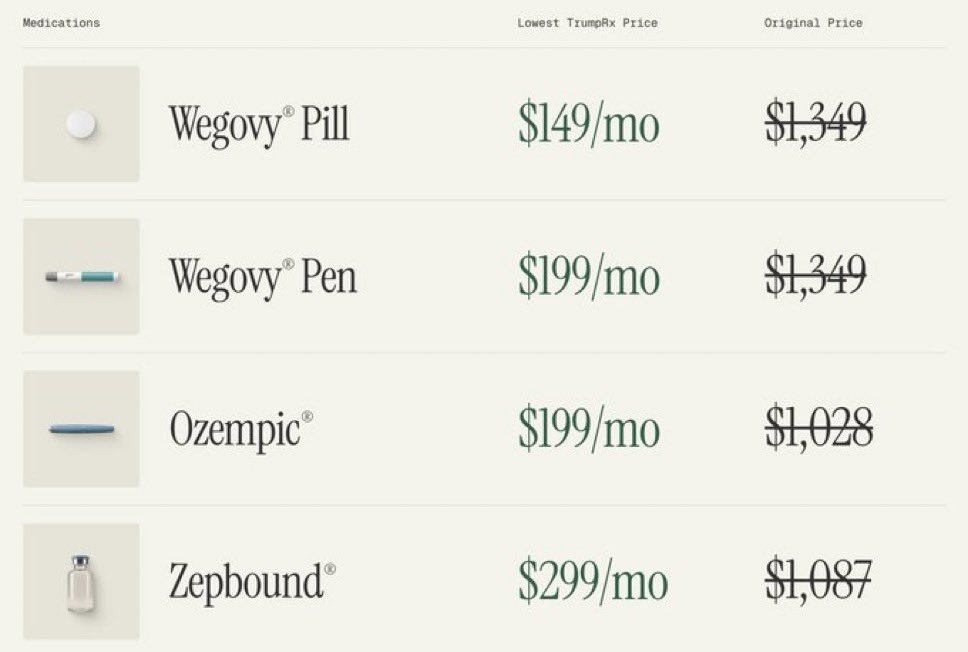
The world is getting skinnier and more disciplined. The Trump administration is pushing for weight loss drug prices to come down, and Big Food players are preparing for the aftermath of changes GLP-1s will have on consumer behavior. McDonald’s is experimenting with less sugary drinks, more protein; Pepsi is “leaning into portion control.” GLP-1s are only a magic pill insofar as they actively suppress your appetite, but it turns out, many people now on these drugs were simply eating more than they needed. Like many, I’ve maintained a healthy skepticism about the benefits of such a pill. On one hand, I marvel at the scientific feat that we might someday meaningfully reduce obesity. On the other, there are many negative side effects—pancreatitis, low bone density, the list goes on.
But strangely, in our fixation over magic weight loss, there are other side effects that we’re not talking about. Side effects that carry a certain moral fuzziness, enough to make even art gallerists like Ellie Rines skittish:
If someone can turn down a cookie, they can turn down the delicious satisfaction of buying an artwork, too. I’m still in the impulse sector over here.
Her biggest challenge in today’s art market, she says, is “counteracting GLP-1s.”
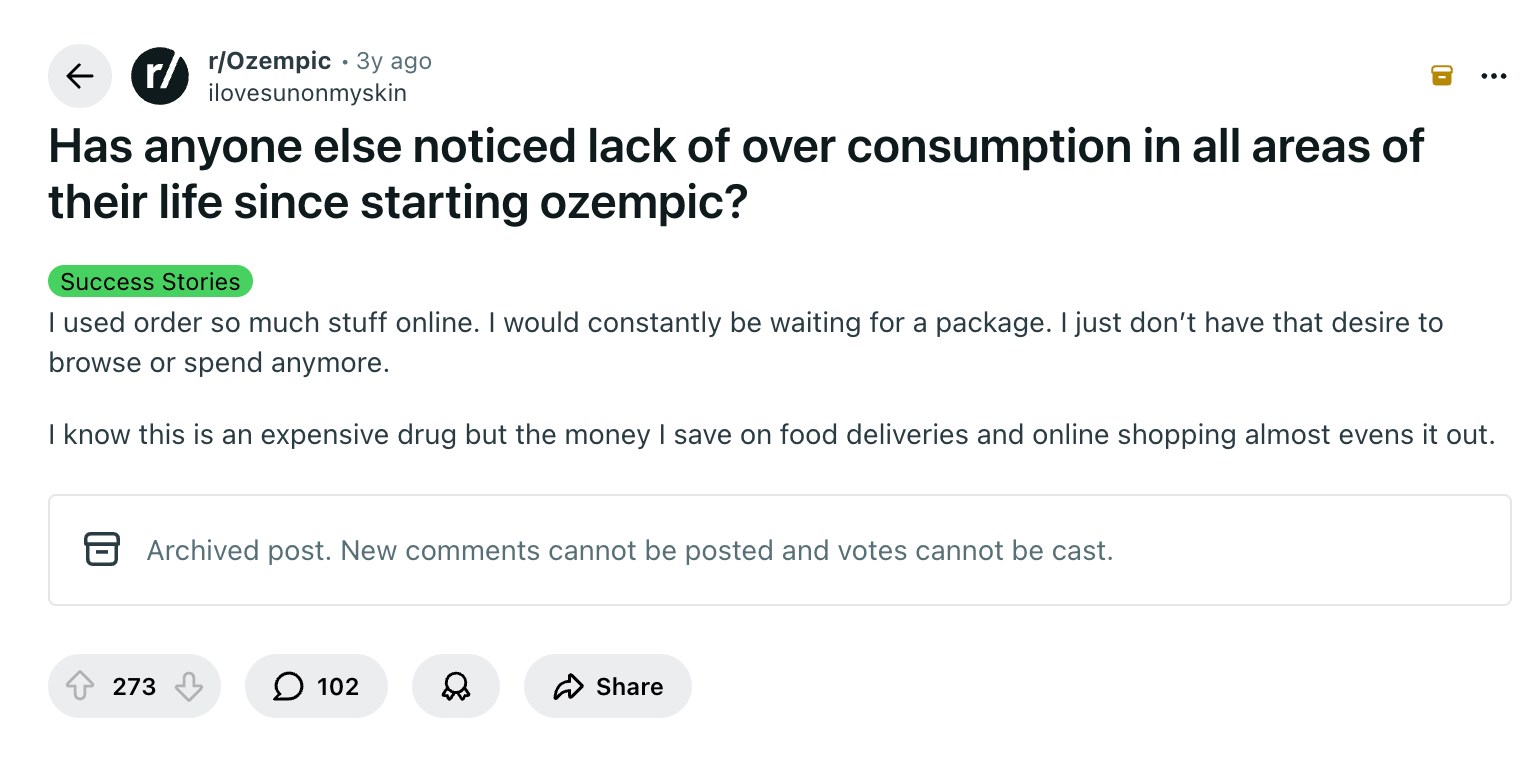
Ozempic’s impact on the art world seems like a stretch, but I’m not convinced the worry is intentionally provocative, nor does it seem to stop at art. The small-scale studies and personal anecdotes of GLP-1s’ effectiveness at reducing addictive behaviors like gambling and shopping are early rumblings of what kind of society we might find ourselves living in. How we consume, what we feel compelled to want—and, on a more philosophical level—what’s lost when desire is dulled. A flat life might fix vices but starve virtue too.
Glucagon-like peptide-1
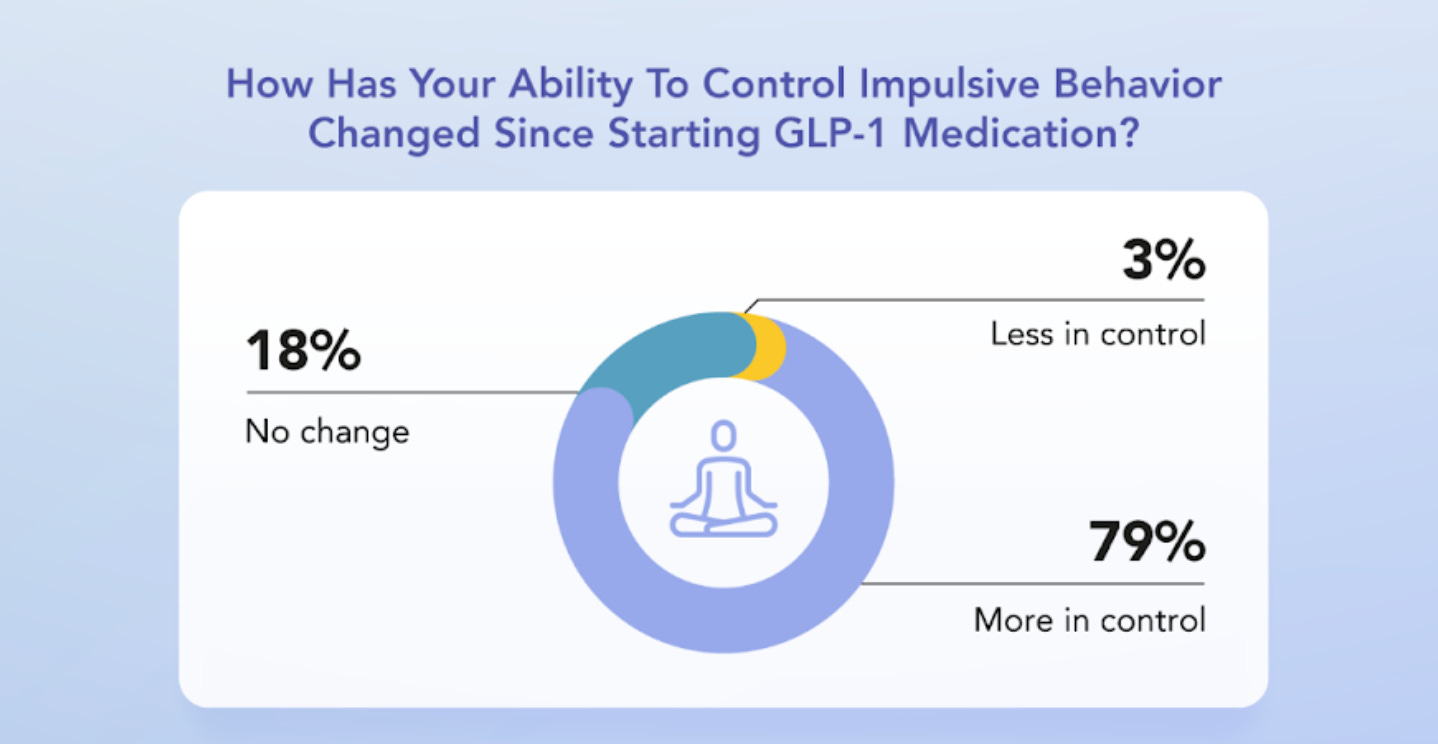
Reduced substance use, quitting drinking alcohol entirely, less impulsive shopping and screen time. These are the reported changes in broader wellbeing from a survey of 1,000 GLP-1 users. It’s a small study, but these early signals are rooted in real and ongoing research on GLP-1s effectiveness in treating addiction.
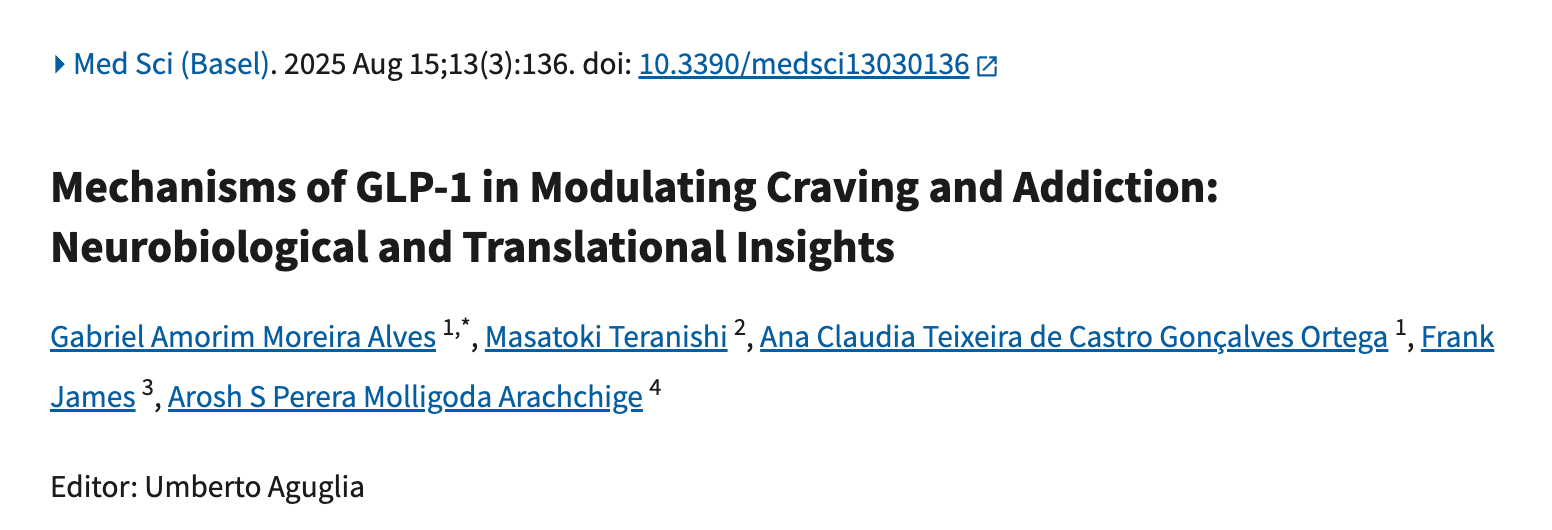
While traditional treatment for addiction has focused on dopamine, there’s growing research to support the often overlooked interplay between the gut-brain axis, including metabolic and hormonal pathways. Scientists suspect GLP-1s may be a promising antidote for addiction, affecting the brain’s reward circuitry and modulating dopamine, glutamate, and GABA involved in craving and reinforcement. In other words, the same biological mechanisms that make us want another slice of cake may also be responsible for wanting another drink, another splurge, or hit of stimulation.
Large-scale human trials are still needed to determine effectiveness. However, compared to other addiction treatments currently in trial, GLP-1s have a clinical advantage having already been FDA approved for diabetes and obesity. The path toward adoption for multi-purpose use cases looks strong and could have a much quicker turnaround time. And while addressing severe addiction is a real and non-trivial pursuit, the already present ease of accessibility (even to children as young as 12) makes this a much broader societal experiment in appetite and impulse regulation.
Nearly one in five adults say at some point they have taken a GLP-1 drug, and rough estimates suggest at least 35 million people are taking them currently across North America. That’s not an insignificant number of the population who are already on GLP-1s and will likely stay on them for the long term. But when the tunnel vision is fixated on weight loss, most are not even considering the other downstream effects of pledging allegiance to this miracle drug.
The cure-all pill
Prediction: We’ll use GLP-1s to treat phone addiction.
I had a dinner party over the weekend with friends across different industries, some in tech, but also a few photographers, a steelworker, a dance studio owner. The conversation that was an instant icebreaker was the group’s unabashed phone addiction confessionals. Everyone gathered around the kitchen talking about the measures they were taking to reduce their screen and social media time, whether it was using a physical barrier like Brick or attending silent meditation retreats.
In case you haven’t noticed, being chronically online is no longer just uncool. There’s a growing recognition that hitting a daily average of 8+ hours on your phone is a sign you’re genuinely addicted.
Surprisingly, AA-equivalent support groups for phone addiction are still few and far between in North America, unlike China who has treated internet and phone addiction as a formal social problem far more aggressively [see internet addiction camps]. Keep in mind, China formally recognized internet addiction (网瘾 wangyin) as a severe disorder in 2008, and their implementation of top-down policies have created a cultural baseline for overuse as a health and discipline problem, not just a lifestyle choice. Phone addiction has become such a pervasive social and public health issue here in North America that I see no reason why it won’t increasingly be taken much more seriously beyond the informal treatment to date with app-blockers and other tech-enabled solutions.
The trend toward being skinnier à la Ozempic tracks with the ongoing desire to lead a healthier lifestyle, including limiting screen time. And I predict GLP-1s will play a significant role both in treating phone addiction as a primary use case, and as a secondary effect of using GLP-1s more generally. For one, there’s a clear and pretty obvious path to adoption, as evidenced by its accessibility. But as early research is already revealing, those already on GLP-1s are effectively rewiring the circuitry of their brains, altering what they desire and consume, and feeling more in control of their consumption behaviors.
Consumer capitalism’s grey swan
Economists call a “grey swan” an event that isn’t unimaginable, but whose consequences are wildly underestimated.
Companies are so fixated on how AI will disrupt their industry, but the grey swan hiding under our noses may actually be a widespread change in how people consume and the second-order effects on modern consumer capitalism. Online shopping and ecommerce behavior, the content people choose to watch, and the marketing tactics that actually sell may all be radically disrupted sooner and for different reasons than we think.
For instance, it’s common knowledge in advertising that capitalizing on human emotions like scarcity and urgency are effective forms of influence. That landscape is already changing, and yet still, I find a plentiful number of emails in my inbox with “last day to get 25% off!” and “only 1 left.” Increasingly, this kind of copy will be ineffective on a population whose strong impulse control does not make them feel wanting of a quick dopamine hit.
Short-form content, and in some cases the sloppification of branding and content, has become a common bet in a savvy consumer marketer’s rolodex. But there’s a world where channels that prioritize long-form and substance (hint: Substack) take the lead and become highly preferred. Seeing as they won’t just accept massive drops in usage, what will major social media platforms like TikTok and Instagram do when the attention economy is thwarted? Will they dig their heels in more aggressively with users who remain, adopting new seductive methods for engaging users who are now neurochemically addicted?
With the caveat that AI will play a non-trivial role in making advertisements hyper-personalized to the user (ads in ChatGPT have already begun), there will always be a place where authentic human-to-human marketing like WOM is valued. Substance will become a non-negotiable. This inevitably bleeds into how we devise human reputation systems, caring more about something based on who you know and trust, and experiential offline activities with more curated groups of friends.
The widest adoption of GLP-1s is in North America, where the US has over 30 million users compared to China’s roughly 2-4 million. Even though China’s market is rapidly developing new patents for weight-loss drugs, their Ozempic sales have actually fallen. In China, GLP-1s are not widely reimbursed, are expensive, and mostly prescribed for diabetes rather than cosmetic weight loss. Like the TikTok drug that has been heavily banned at home, China’s reluctance to dogfood their own GLP-1s at scale should make us think twice.
This experiment will no doubt have adversarial effects on the American political economy where consumer spending will be at worst reduced, at best reallocated. This is already materializing across food spending. Cornell researchers found that within six months of starting a GLP-1, households cut grocery spending by 5.3% on average, with a larger drop for higher-income households, and cut spending at fast food, coffee shops, and other limited-service restaurants by about 8%. Professor Sylvia Hristakeva points out that this decline was not just for the ultra-processed, calorie-dense:
The main pattern is a reduction in overall food purchases. Only a small number of categories show increases, and those increases are modest relative to the overall decline.
One could interpret this more optimistically. For decades, economists and environmentalists have warned that advanced economies may have reached a point of overconsumption. GLP-1s could mark a positive shift that we are approaching peak consumption. If consumer capitalism has been optimized to manufacture desire without meaningfully improving wellbeing, perhaps we are finally approaching the limits of that model.
A bane for compulsion-adjacent categories may become a boon for credit and insurance companies. Fitness tracker data has already become embedded in life insurance to help with underwriting. If GLP-1s become a recognizable signal of impulse-control, it would not be shocking to imagine prescription history being taken into account in credit scores or insurance premiums. It’s somewhat dystopian that we might consider pricing access to capital and insurance coverage based on someone’s “impulse profile.”
But once a behavior or drug becomes embedded in everyday life, it becomes difficult to roll back. There’s good reason to believe GLP-1s could be a net positive for reducing obesity, diabetes, and cardiovascular disease, but we’re still operating without full certainty about the broader societal tradeoffs. Unlike the anti-smoking campaigns (which still took nearly fifty years to prove effective), GLP-1s are heavily associated with positives like weight loss and visible status improvement, not visible stigma—yellow teeth, bad breath, black lungs, and an inherently public activity. In other words, how do you encourage a population dependent on GLP-1s, especially for cosmetic purposes, to stop taking the drug when they want to stay skinny?
Capitalism hinges on our continued desire to consume. To constantly be in a state of wanting. GLP-1s won’t wipe that out entirely, but at the very least will disrupt those industries founded on excess consumption and our impulsivity to spend: alcohol, gambling, gaming, fast fashion, fast food, social media.
Modern capitalism optimizes for stimulating desire. GLP-1s may be the first large-scale pharmaceutical that dampens it.
Silicon valley biohacking
The latest rumor of a rumor is that hedge funds are banning GLP-1s from their traders. From Matt Levine:
A few months ago, someone told me that they had heard a rumor that a bank or hedge fund had banned its traders from taking Ozempic, Wegovy and other GLP-1 weight-loss drugs. The theory, as I understood it, was something like “traders need to make quick decisions based on gut instinct, and GLP-1s mess with your gut instincts.” You’re not hungry for snacks, you’re not hungry for profits, you lose your edge. I have not confirmed this rumor, or heard it from anyone else, but se non è vero, è ben trovato. (If your job bans you from taking GLP-1s, do let me know!)
In an obsession with optimizing every granular facet of their lives, Silicon Valley biohackers are taking Retatrutide and Tirzepatide to looksmaxx or, for some, use their bodies as an experiment to achieve immortality. To give no indication that there’s an ounce of discipline they don’t possess.
Without disparaging the necessity for those who clinically need it, I can’t help but wonder if GLP-1s in many tech circles are just another optimization trend. In Silicon Valley, the mythology of earned discipline is treated as a personal virtue. The mythos that founders succeed because they possess superhuman levels of self-mastery is expressed through things like 996 culture, fasting and cold plunges, biohacking and productivity optimization. Unlike stimulants, peptides don’t directly increase focus, but pharmacologically reduced impulses can easily be mistaken for exceptional self-control.
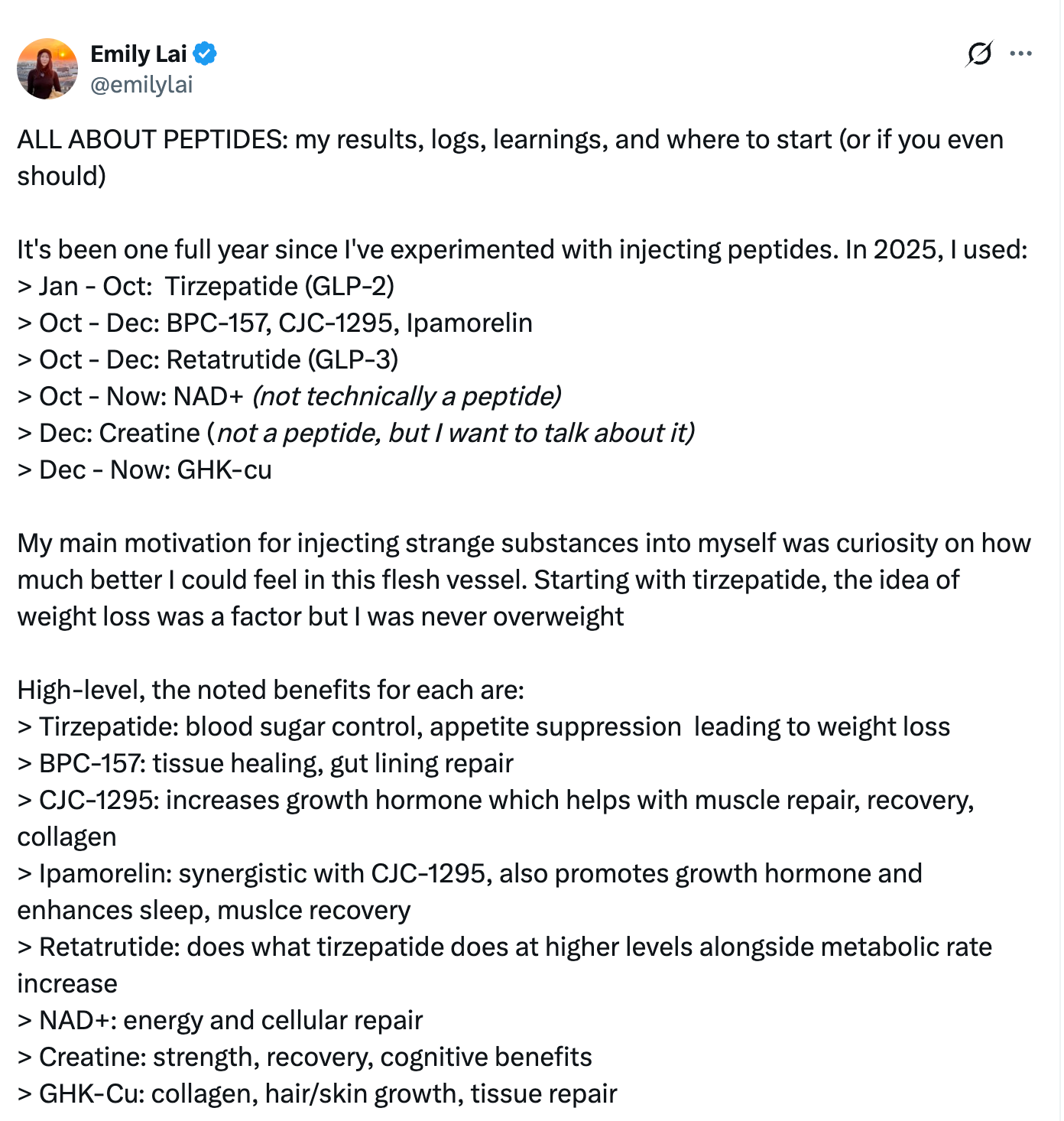
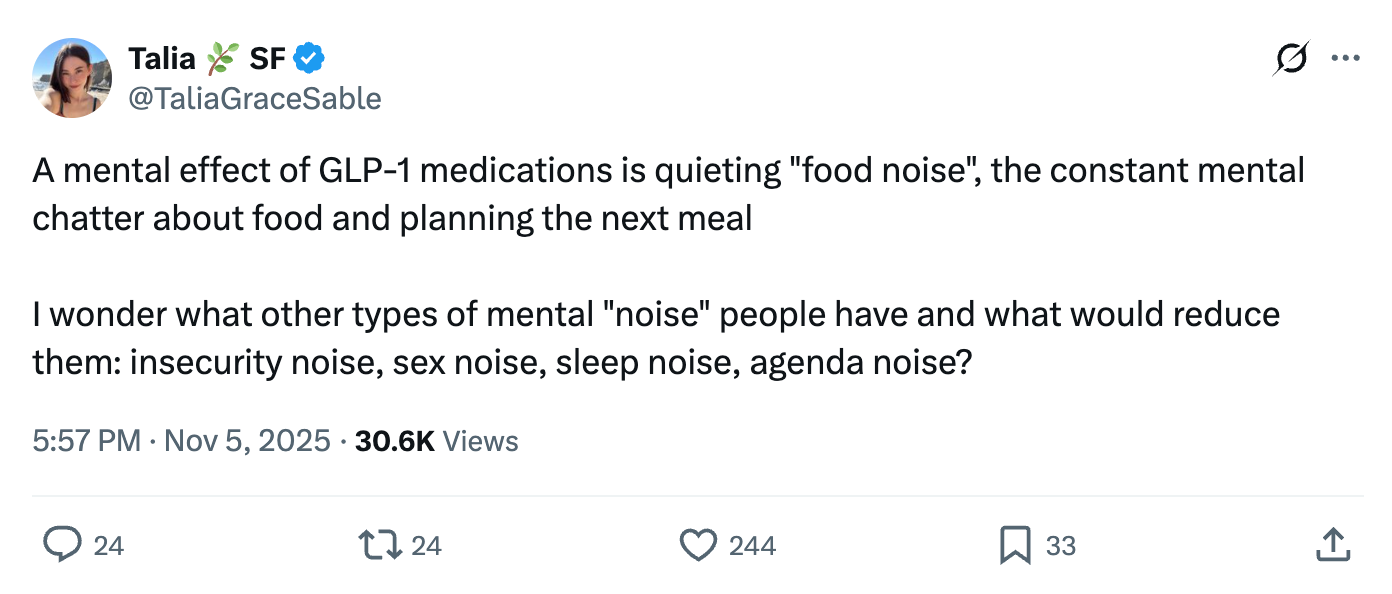
Still, maybe there’s a hidden cost to optimization that’s being glossed over. The ultra-disciplined, strong impulse-controlled founder might play their business strategy too safe. The venture capitalist might opt for fewer moonshot investments for a more conservative portfolio. The artist may have fewer bursts of creative focus. There’s some amount of obsessiveness and compulsive drive that makes the world go round. Tinkering at the edges is where we see breakthroughs in progress. Without catastrophizing the drug, there’s a scenario where GLP-1s could actually lead to midcurve.
It may seem trivial to focus on GLP-1s when performance-enhancing drugs have been used recreationally for years. But lifestyle adoption of GLP-1s has already exceeded drugs like Adderall by about 5% in a span of only a few years. This isn’t a small segment of the population occasionally experimenting with drugs, it’s a widespread lifestyle shift.
Low-desire living
This self-reported ennui begs a deeper philosophical reflection of what we might lose. A recent post by Dr. Shin Geon-yeong went viral for his prediction that people on GLP-1s will have difficulty falling in love. No published clinical evidence links GLP-1 agonists to lowered oxytocin—in other words, his claim is likely a stretch—but many commenters on peptides recall being shocked by how much the drugs lowered their libido, as an unintended consequence.
Evidently, this lifestyle drug is already creeping into many aspects of life, and it’s only the beginning.
But on a purely philosophical level, I wonder what short-circuiting impulse control does to someone’s agency. Do you lose the trust in yourself to get through hard things? How much do we value our own self-control as evidence of willpower?
A friend shared an analogy that I keep circling back to. In the wild, plants grow under constant wind. The movement forces them to develop thicker stems and deeper roots. Gardeners sometimes shield backyard plants with barriers like burlap or chicken wire so they grow straighter and more protected.
There’s nothing inherently wrong with either environment. But they produce different kinds of growth.
I can’t help but wonder if GLP-1s are doing something similar to us. By dampening appetite and impulse, they may be removing some of the internal “winds” that have long shaped human behavior—craving, restlessness, excess, obsession.
These forces create plenty of vice. But they also create ambition, art, risk, and love.
If a growing share of society begins chemically smoothing those impulses away, we may become healthier, more disciplined.
But we may grow differently, too.
~
Sam
If you liked this essay, you might also like:
Serious thinking has gone offline

Something is pulling people out of their screens again. In late 2025, Edge City ran a month-long popup village in Patagonia. Hundreds of builders, artists, and researchers lived and worked together, co-creating more than 700 unconferences and piloting a new residency program. A multi-day protocol sprint was held with the Ethereum Foundation. An AI pipel…
Great piece! Love the writing you've been doing
very intriguing indeed, we may just grow indifferent, toward more NPC-life... I'd love to experiment it once, just to see how I feel